Lucas and Magalí's email correspondence
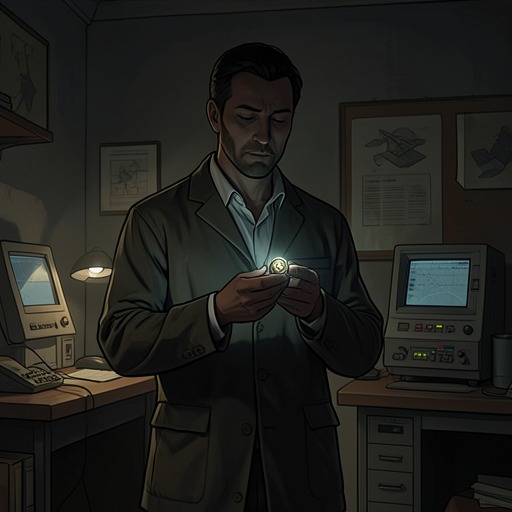
La uruguayaLucas and Magalí's email correspondence is both the infrastructure of their long-distance attachment and the private space Lucas tries to keep separate from his marriage to Catalina. Its messages arrange a meeting in Montevideo and carry songs and glimpses of the city across the border, but their secrecy also makes the correspondence a source of suspicion. When Catalina discovers a message addressed to Guerra, the private channel that Lucas guarded becomes one of the routes by which his attachment is exposed.
A private channel and a planned meeting
From the ferry, on his way to Uruguay, Lucas Pereyra writes to Magalí Guerra Zabala to say that he is coming and ask whether she can meet at two. Her reply agrees to the time and specifies the same place as their previous meeting. The brief exchange turns his journey into a plan shared between them: the crossing is no longer only an escape from his ordinary surroundings but a passage toward a particular person. Lucas receives her answer when his phone finds a signal near Colonia, making the message arrive in the midst of the trip it helps direct.
The brevity of the arrangement contrasts with the emotional weight Lucas assigns to it. He recalls reading the reply while looking out at the river and saying Magalí's name to himself. The correspondence does not need to state what the meeting means for him; his response supplies that meaning. Their emails offer a restrained, practical surface for an attachment that, in his private account, has become intense.
Lucas presents email as a protected room within his marriage. He says he never left his account open and took comfort in having a part of his mind that he did not share with Catalina. To him, this privacy was not merely concealment of a particular message but a defense against what he feared as the couple becoming one fused, mirrored being. He imagines the child, Maiko, as completing that bond and describes the loss of individual boundaries as suffocating. His insistence on a private corner therefore makes the mailbox a symbol of separateness as well as a practical means of communication.
Messages that make a city
The correspondence also gives Lucas a mediated version of Montevideo before and during his visit. Roughly every two weeks, Magalí sends him material by email: a song, a video from Tiranos temblad, or footage of streets in her city. Lucas treats these messages as small traces that keep him oriented toward a place he has not yet come to know directly. His own experience of Montevideo consequently begins as an arrangement of remembered images, online links, and a few personal recollections.
One song becomes especially bound up with the attachment. Lucas has watched a video of two musicians performing Te abracé en la noche repeatedly, humming the song at home while Catalina remains unaware of what is consuming him. The song’s association with parting gives his anticipation of Magalí a melancholy undertone. When he walks along Avenida 18 de Julio, the streets feel charged with the possibility that one of their bars might be the place shown in the video. He recognizes that he is in love both with a woman who lives in Montevideo and with a city he has largely invented from what she has sent him.
A link to a solo album by the singer of Blur gives him another way to imagine the city. Its cover shows Palacio Salvo, and, when Lucas later sees the building, he connects the real landmark to the image Magalí shared. That remembered link shapes his attention: the building is not simply a sight in the street but part of a chain of associations running from her email through music and into his present walk. The correspondence thus acts as an informal map, guiding not his route alone but the meanings he attaches to what he sees.
Secrecy, inference, and discovery
The messages leave important gaps. Lucas says Magalí's email address uses initials and a number, and that she does not sign her messages with her full name, sometimes using only her initial. In the body of the correspondence, he calls her Guerra. When Catalina later asks who Guerra is, Lucas understands that she has seen an email but is unsure whether she knows whether Guerra is a man or a woman. He replies that Guerra belongs to the group that invited him to Valizas, avoiding a direct answer while he tries to think of what to say next.
Lucas speculates that Catalina may have found the email open on a tablet after he used it to put on a video for Maiko. He cannot establish exactly how she saw it, but the possibility exposes the fragility of the privacy he thought he had secured. The episode also draws on an earlier breach: Lucas says Catalina had heard him say Guerra's name in his sleep. The surname therefore reaches her through two different channels, one written and one spoken without his awareness. His attempt to keep the relationship compartmentalized has already left traces outside the mailbox.
The correspondence also marks a boundary in what the two discuss. During his walk in Montevideo, a tattoo-shop flyer prompts Lucas to think about Magalí's genital piercing, but he notes that their back-and-forth emails had never addressed it. The contrast is revealing without proving that the messages contain a full account of either person's life: they sustain closeness while leaving subjects untouched. For Lucas, each omission can become a space for speculation rather than a settled understanding.
From correspondence to disclosure
In the later conversation Lucas recounts with Catalina, she asks him directly who Guerra is, and he tells her about his distant attachment to Magalí. He takes this confession to be less consequential than what Catalina is about to disclose, but the correspondence has already helped make his attachment legible: there is a named correspondent, a planned meeting, a prior encounter, and a message discovered by his wife. The exchange that once seemed to Lucas like a private refuge has become part of the evidence through which the marriage confronts what each partner has kept from the other.
The emails never erase the distance between Lucas and Magalí or make their relationship fully knowable. Instead, their significance lies in how much they carry despite their brevity. A meeting time points toward an encounter; recurring videos let a city become an object of longing; an address and a surname offer just enough information to invite inference; and a message left accessible can overturn the sender's sense of control. In Lucas's account, the correspondence is at once an intimate lifeline, an imaginative map, and a fault line in his marriage.